
For years, businesses focused almost entirely on ranking in Google. The goal was simple: secure a top position on search engine results pages and generate traffic.
That model is changing.
Today, people increasingly ask questions directly to AI systems like ChatGPT, Gemini, Perplexity, and Google’s AI-powered experiences. Instead of showing ten blue links, these platforms often generate direct answers and recommendations.
This shift creates a new challenge for businesses.
Many companies that once ranked well are discovering that they are barely mentioned in AI-generated responses. They are online, but they are not being discovered.
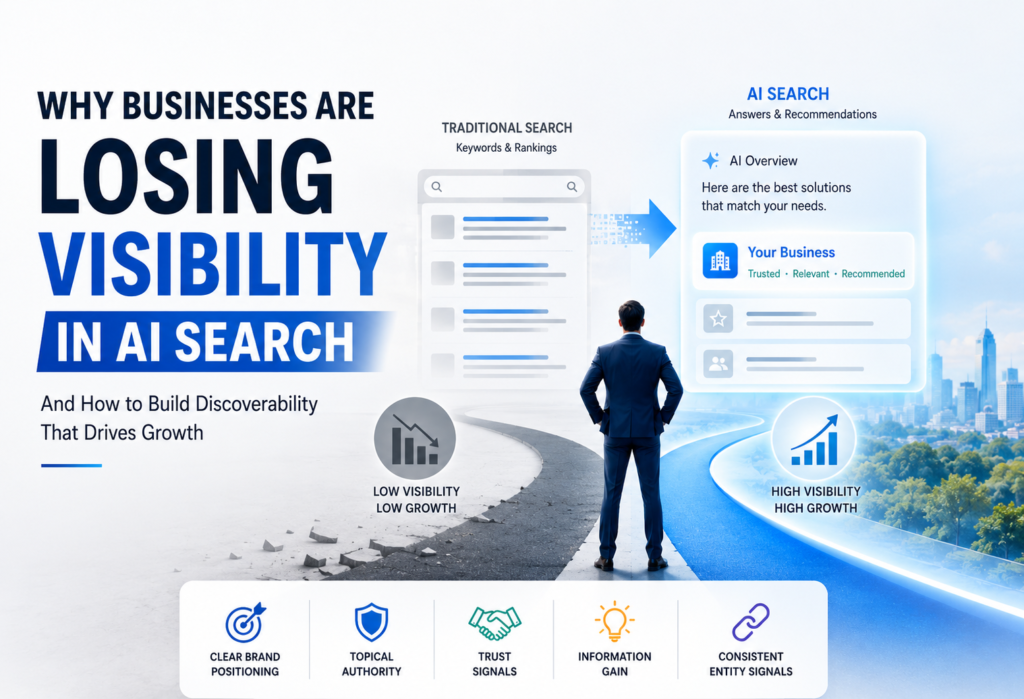
The problem is not that AI search has replaced traditional search engines. The problem is that discoverability now depends on more than keywords and rankings.
The Shift From Search Engines to Answer Engines
Traditional search engines primarily index pages and rank them according to relevance and authority signals.
AI systems operate differently.
They attempt to understand topics, entities, relationships, and trust signals before generating responses. Instead of simply displaying pages, they synthesize information and present answers.
This means businesses need to become more than websites with keywords.
They need to become recognized digital entities.
In simple terms, businesses must be easy to understand, easy to verify, and easy to trust.
Why Businesses Are Becoming Invisible
Inconsistent Brand Information
Many businesses have different descriptions, services, and contact details across their website, social profiles, and business listings.
AI systems struggle to determine which information is accurate.
Confusion reduces confidence.
Lower confidence often means lower visibility.
Weak Topical Authority
Publishing occasional blogs about unrelated topics rarely builds expertise.
AI systems look for patterns.
Businesses that consistently educate around specific subjects are easier to identify as authoritative sources.
Lack of Trust Signals
Trust signals include:
- Reviews and testimonials
- Media mentions
- Expert content
- Business citations
- Author profiles
- Case studies
- Industry recognition
Without these signals, businesses become difficult to validate.
Thin Content
Many websites publish articles that repeat information already available elsewhere.
Commodity content rarely demonstrates expertise.
If a piece of content could belong to almost any company, it does little to strengthen brand authority.
No Digital Entity Building
Most businesses still optimize only for keywords.
Modern discoverability increasingly depends on entity understanding.
Businesses that clearly communicate who they are, what they do, who they serve, and why they are credible create stronger recognition signals.
The Five Pillars of AI Discoverability
Pillar One: Clear Brand Positioning
Businesses should clearly define:
- Who they serve
- Problems they solve
- Their expertise
- Their differentiators
Ambiguous brands are difficult for both humans and AI systems to understand.
Pillar Two: Topical Authority
Authority comes from depth.
Instead of creating hundreds of disconnected articles, businesses should build comprehensive knowledge around a few strategic themes.
For example, a healthcare marketing agency may consistently publish content around:
- Healthcare SEO
- Reputation management
- Patient acquisition
- Local search visibility
Over time, this creates stronger expertise signals.
Pillar Three: Trust Infrastructure
Trust is becoming one of the most valuable digital assets.
Businesses should continuously strengthen:
- Reviews
- Testimonials
- Author profiles
- Media coverage
- Case studies
- Educational resources
Trust influences decision-making and discoverability.
Pillar Four: Information Gain
AI systems increasingly prioritize content that teaches something genuinely useful.
Businesses should publish:
- Original frameworks
- Decision models
- Industry observations
- Real examples
- Practical implementation guidance
Information gain differentiates expertise from repetition.
Pillar Five: Consistent Entity Signals
Every digital touchpoint should reinforce the same business identity.
Website.
Google Business Profile.
Social platforms.
Directories.
Media mentions.
Educational content.
Consistency makes businesses easier to recognize and trust.
A Practical Business Scenario
Consider two digital marketing agencies.
The first publishes generic articles like:
“10 SEO Tips”
“5 Marketing Tricks”
“Social Media Ideas for Business”
The second publishes in-depth resources explaining:
Why local businesses fail to build authority online.
How entity-based search influences discoverability.
How trust signals affect lead generation.
The second agency is more likely to be perceived as an expert because its content demonstrates understanding, context, and practical knowledge.
Authority compounds over time.
Implementation Framework
Step 1: Audit Digital Presence
Review:
- Website messaging
- Google Business Profile
- Social profiles
- Directory listings
- Existing content
Identify inconsistencies.
Step 2: Define Expertise Areas
Choose strategic topics where your business can genuinely demonstrate experience and knowledge.
Avoid covering everything.
Own specific areas.
Step 3: Create Authority Content
Develop content that:
- Explains concepts clearly
- Solves real business problems
- Shares practical insights
- Demonstrates experience
Step 4: Build Trust Signals
Collect:
- Reviews
- Testimonials
- Case studies
- Media mentions
- Expert contributions
Step 5: Measure Progress
Track:
- Branded searches
- Organic visibility
- Referral traffic
- Mentions across digital platforms
- Lead quality
- Engagement metrics
Common Mistakes Businesses Make
Publishing content solely for keywords.
Creating articles without practical value.
Ignoring brand consistency.
Chasing traffic instead of authority.
Producing large volumes of thin content.
Treating AI discoverability as a technical trick rather than a trust-building process.
Frequently Asked Questions
Is traditional SEO still important?
Yes. Traditional SEO remains important, but discoverability increasingly depends on authority, trust, and entity understanding.
Does AI search eliminate the need for websites?
No. Websites remain foundational assets. They provide the content, expertise, and trust signals that AI systems rely upon.
Can small businesses compete?
Absolutely. Smaller businesses often succeed by focusing on expertise, consistency, and high-quality educational content.
How long does it take to improve discoverability?
Authority building is a long-term investment. Meaningful improvements usually occur through consistent publishing, trust building, and brand positioning over time.
The Spidy Monk Perspective
Businesses should stop asking, “How do we rank for this keyword?”
The better question is, “How do we become the most trusted source on this topic?”
Search engines and AI systems are increasingly rewarding businesses that demonstrate expertise, provide unique value, and build trustworthy digital identities.
The companies that win the next era of search will not necessarily publish the most content.
They will publish the most useful content, create the strongest trust signals, and establish the clearest authority within their markets.